

'India is a huge market for Chinese goods. I don't think a war stands to logic when you have economic compulsions, but then Chinese are known to do illogical things.'

What is so honourable in defending or dis-honourable in not defending the 'Johnson line' in Aksai Chin? That is a question that needs to be asked to the Indian shouting brigade. The Chinese also need to be asked as to why they wish to implement the 'MacDonald McCartney' line drawn by British Imperialists? asks Col (retd) Anil Athale.
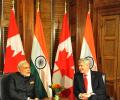
Canada will supply uranium to energy-starved India beginning this year over a period of five years, a decision which was termed as a launch of a new era of bilateral cooperation and mutual trust by Prime Minister Narendra Modi.
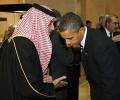
Further deterioration of the US-Saudi relationship will have geo-economic and geopolitical effects, says Nitin Pai.
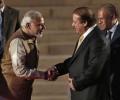
Prime Minister Narendra Modi's real test will be whether he can bring a longer-term vision to India's foreign policy planning, says Ravi Agrawal.

Even as the United States snuggles closer to India with the thinly veiled objective of containing China, the Indian strategy is to avoid alienating either nation.

The new equation between 'Namo' and 'Barack' may well 'convert a good start into lasting progress.'

From the Syrian civil war to the Ukrainian crisis to the terror unleashed by the dreaded Islamic State, there was no lack of news in 2014. In this five-part series,rediff.com presents a selection of the year's most enduring moments year from around the world.

'It is a diamond which has a very long competitive history.'
'Why not ask for a change of leadership in Qatar, Bahrain or Saudi Arabia? Is there a constitution in Saudi Arabia? Are there elections in Saudi Arabia? Why no talk of democracy in these countries?' 'America said change the leader now, but is now ignoring the feelings of the Syrian moderate majority. Is that democracy,' asks H E Dr Riad Abbas, Syrian ambassador to India, in an interview to Cleo Paskal.

'The use of nuclear/biological/chemical weapons by Islamic terrorists is just a matter of time.' 'It must be clearly understood what the world faces is a global level insurgency against the world order.' 'Terrorism is merely a tactic and Islamic State its most brutal face, says Colonel Anil A Athale (retd).
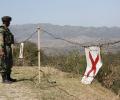
'The response to terror is not always reciprocal terror, nor is launching a conventional response the best response.' 'The best response is to make the sponsor pay a price he cannot afford,' says former RA&W chief Vikram Sood.

Obama's decision to visit India must be a result of his judgement that Modi is a man of action, feels Ambassador T P Sreenivasan.

Its promise has fallen short before the onslaught of the votaries of the old order and ruthless extremist forces, notes Talmiz Ahmad.

'Modi is a symbol of Asia Rising; and, for the first time in decades, a non-white has the potential to be the most compelling global leader.'

'To expect that he has a magic wand to resolve all differences and announce breakthroughs in all issues during his first visit to the US is to be unrealistic,' says Ambassador T P Sreenivasan.

Silicon Valley can be replicated, but this will only be achieved so long as fresh talent is welcomed by both our countries - a move that will surely spark a billion ideas and discoveries.

The Nobel Prize for Malala may have caused deep divisions across the globe and disturbed the peace, while the award to OPCW, though not without critics, may have served the cause of peace by eliminating a weapon of mass destruction from the face of the earth, says Ambassador T P Sreenivasan.

Meet Cassie de Pecol, a 27-year-old traveller from Connecticut, United States, who visited 196 countries in 18-and-a-half months, making her the fastest person to visit every country in the world.

Narendra Modi speaks to CNN's Fareed Zakaria in his first interview after becoming prime minister. The excerpts

'India has to judge what Pakistan says to us, not what they say to a domestic audience,' a source tells Sheela Bhatt/Rediff.com, explaining why India-Pakistan talks remain on track despite discordant noises from across the border.

India needs to build its Grand Narrative, and its cultural power, which conquered all of ASEAN (then known as Indo-China), needs to be forcefully projected while simultaneously hard economic and military power are also emphasised, says Rajeev Srinivasan.

Has New Delhi internalised the truth that it does not matter, asks Saeed Naqvi. Such deafening silence from the government, principal opposition, even the pundits!

Despite a lot of lip service to national unity, functional relations between the Han Chinese immigrants and the Uyghur regional majority have not developed on equitable basis, says R Hariharan
'Modi wants to be pragmatic -- acknowledge the problem of Pakistan and that full reconciliation is essentially a non-starter, but at the same time grab the low-hanging fruits (such as trade) to put things on a more even keel, to engender enough stability in the relationship to allow him to focus on other priorities.'

In his penultimate State of the Union address, Barack Obama said that the economy is improving.

'It is only because we were facing US threats that we were able to successfully develop a nuclear programme of our own.'
 © 2026 Rediff.com - Advertise with us - Disclaimer - Privacy Policy - Sitemap - Feedback - About us - Terms of use - Grievances